The BenQ RD series is a family of programming monitors optimized for developer workflows. Its core value lies in reducing glare, improving code readability, and easing visual strain during long coding sessions. This article focuses on the differences in specs and usage scenarios across the RD270Q, RD280UG, and RD280U, helping developers choose precisely based on refresh rate, 3:2 aspect ratio, and eye-care capabilities. Keywords: programming monitor, eye care, 3:2.
The technical specifications provide a quick comparison
| Parameter | RD270Q | RD280UG | RD280U |
|---|---|---|---|
| Product Type | Programming Monitor | Programming Monitor | Programming Monitor |
| Panel Size | 27 inches | 28.2 inches | 28.2 inches |
| Resolution | 2K | 4K | 4K |
| Refresh Rate | 144Hz | 120Hz | 60Hz |
| Aspect Ratio | 16:9 | 3:2 | 3:2 |
| Contrast Ratio | 1300:1 | 2000:1 | 1200:1 |
| USB-C Power Delivery | 65W | 90W | 90W |
| Eye-Care Features | Hardware Low Blue Light, Anti-Glare, Flicker-Free | Same as left + MoonHalo | Same as left + MoonHalo |
| Collaboration Features | USB-C, KVM, Display Pilot 2 | USB-C, KVM, Display Pilot 2 | USB-C, KVM, Display Pilot 2 |
| Best For | Frontend, Backend, AI, Game Development | Backend, Algorithms, Data Engineering | Late-night coding, users with strong eye-care needs |
| Language | Non-software product | Non-software product | Non-software product |
| Interfaces | DisplayPort / HDMI / USB-C | DisplayPort / HDMI / USB-C | DisplayPort / HDMI / USB-C |
| Star Count | Not disclosed | Not disclosed | Not disclosed |
| Core Dependencies | Anti-glare panel, hardware low blue light, coding mode | 3:2 panel, MoonHalo, coding mode | DualView Plus, MoonHalo, night mode |
These three monitors solve the same class of visual and productivity problems for programmers
The most valuable takeaway in the original information is not any single spec, but the workflow-oriented design. The RD series does not lean on gaming-style marketing. Instead, it addresses three high-frequency pain points: glare that breaks concentration, eye fatigue from reading code for long periods, and low efficiency when switching across multiple windows.
For developers, a monitor is not just an output device. It is the shared workspace for the IDE, terminal, browser, documentation, and debugger. As soon as screen reflections become noticeable or character separation becomes unclear, attention gets interrupted repeatedly.
The shared RD series feature set establishes a strong baseline experience
All three models include an anti-glare panel, hardware-level low blue light filtering, a coding-specific color mode, one-cable USB-C connectivity, KVM switching, and an ergonomic stand. That means no matter where your budget lands, the baseline experience is clearly better than that of a standard office monitor.
Core evaluation order for a developer monitor:
1. Start with aspect ratio and resolution to determine visible code area
2. Then check refresh rate to determine scrolling and window-switching smoothness
3. Finally, evaluate eye-care features and power delivery for long-session stability
This rule helps developers prioritize workflow fit rather than marketing language.
RD270Q is better suited for general developers who want smoother interaction
The key difference with the RD270Q is its 27-inch, 2K, 144Hz configuration. Its value is not primarily in gaming, but in making window dragging, code scrolling, and interface switching feel more continuous. It is especially well suited for frontend, full-stack, and AI engineers who move across applications frequently.
The benefit of 144Hz is very direct in IDE scrolling. When reading long files, tracking logs, or debugging components, ghosting decreases and the visual response feels more immediate. For React, TypeScript, Electron, or game logic debugging, that smoothness can reduce small but persistent cognitive friction.
RD270Q delivers its real advantage in fast switching and fast scanning
Its 1300:1 contrast ratio and light/dark coding modes make keywords, comments, and strings easier to distinguish. The Paper Color Sync mode is better suited to long reading sessions, including documentation, code reviews, and large configuration files.
def choose_rd270q(need_high_refresh: bool, use_laptop_65w: bool) -> str:
    # When high refresh rate is the priority, RD270Q is the more direct choice
    if need_high_refresh:
        return "Recommend RD270Q"
    # RD270Q can also cover laptops that need up to 65W power delivery
    if use_laptop_65w:
        return "RD270Q provides sufficient power"
    return "If vertical viewing space matters more, consider RD280UG/RD280U"
This code summarizes the usage boundaries of the RD270Q through decision logic.
RD280UG stands out with its 3:2 aspect ratio and higher code density
The RD280UG targets coding scenarios that benefit from less scrolling and more uninterrupted reading. Its 28.2-inch, 4K, 3:2, 120Hz combination is fundamentally about increasing vertical content capacity, making it especially suitable for backend development, algorithm work, data engineering, and code review.
Compared with 16:9, a 3:2 aspect ratio displays more vertical content at a similar size. When reading long functions, diffs, SQL, training scripts, or configuration files, your eyes do not need to break context as often. The source article emphasizes that it can display about 18.5% more content, which is highly meaningful for maintaining context.
RD280UG feels more like a productivity display built for code reading
Its 2000:1 contrast ratio improves character edge clarity, while MoonHalo backlighting softens nighttime contrast by adding ambient rear illumination. Combined with 90W USB-C power delivery, it is more suitable for 16-inch high-performance laptops and heavy mobile work setups.
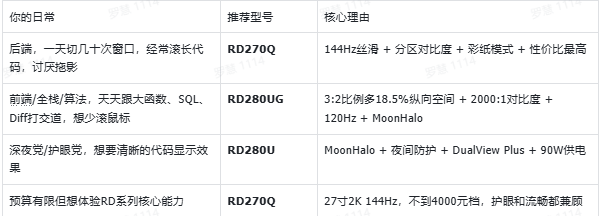 AI Visual Insight: This image supports scenario-based recommendations. The key message is that the three monitors are segmented by developer type and usage scenario, usually through a decision matrix built around size, aspect ratio, refresh rate, and eye-care features. That makes it easier for users to quickly map common workflows such as “high-refresh frontend work,” “long-code backend work,” and “nighttime eye-care-first coding.”
RD280U prioritizes maximum nighttime comfort rather than maximum performance
The RD280U shares the same 28.2-inch, 3:2, 4K foundation as the RD280UG, but lowers the refresh rate to 60Hz in exchange for a more eye-care-focused positioning. It is a strong fit for users who code at night, are sensitive to brightness, or need to handle different visual modes on the same screen.
Its standout capabilities include an ultra-low-brightness night mode, Visual Optimizer, adaptive brightness and color temperature, and DualView Plus. The last feature allows two color modes to appear on one screen at the same time, which is useful for mixed-task layouts such as a dark IDE on the left and a light document on the right.
This is where the line between budget and needs becomes very clear
If you prioritize smoother scrolling and stronger overall display performance, RD280UG is the better fit. If you prioritize nighttime comfort, dual-color parallel viewing, and lower cost, RD280U offers stronger value. It is not a stripped-down substitute. It simply serves a different priority.
function pickMonitor(role, needNightMode, needHighRefresh) {
  // Backend and algorithm roles benefit more from the vertical space of 3:2
  if (["backend", "algorithm", "data"].includes(role)) return "RD280UG";
  // If nighttime coding comes first, RD280U has stronger eye-care advantages
  if (needNightMode) return "RD280U";
  // By default, map high-refresh needs to RD270Q
  if (needHighRefresh) return "RD270Q";
  return "RD270Q";
}
This code compresses the selection logic for the three monitors into an executable scenario-based decision process.
Developers should choose based on workflow rather than spec sheets
If you spend each day switching rapidly among the browser, IDE, terminal, and design files, the RD270Q’s 144Hz is more likely to create immediate value. If your work centers on long codebases, reviews, modeling scripts, or data queries, the RD280UG’s 3:2 aspect ratio will reduce scrolling significantly. If your peak coding hours happen at night, the RD280U’s eye-care strategy will matter more.
The real value of a monitor upgrade is not that it looks more premium. It is that it reduces interruptions to your train of thought. The shared philosophy of the RD series is clear: help programmers forget the screen itself as much as possible over thousands of hours of coding.
The FAQ answers the most common buying questions
Q1: Does 144Hz really matter for programmers?
A: Yes. It primarily improves the continuity of code scrolling, window dragging, and interface switching. It is not useful only for gaming. Frontend, full-stack, and AI developers who switch windows frequently will see the clearest benefit.
Q2: Why is a 3:2 aspect ratio better for backend and algorithm engineers?
A: Because it increases vertical display space. Long functions, logs, SQL, and diffs require less scrolling, preserve context better, and lower the cognitive cost of understanding what you are reading.
Q3: Which model should MacBook Pro users prioritize?
A: For 13- to 14-inch lightweight laptops, the RD270Q’s 65W is usually enough. For 16-inch high-performance models, the 90W USB-C power delivery on the RD280UG or RD280U is the safer choice.
Core Summary: This guide restructures the BenQ RD series monitor lineup for developers, focusing on how the RD270Q, RD280UG, and RD280U differ in high-refresh smoothness, 3:2 code visibility, eye-care features, and multi-device collaboration. It helps frontend, backend, algorithm, and late-night coding users make a fast and accurate buying decision.