Embedded AI Agents are bringing large-model capabilities to low-cost robots and AIoT devices. This article compares the MimiClaw and ESP-Claw approaches, explains their architectural differences, real-time behavior, and practical limits, and helps developers make trade-offs across cost, response time, and extensibility. Keywords: Embedded AI Agent, ESP32-S3, Robot Architecture
Technical Specifications at a Glance
| Parameter | MimiClaw | ESP-Claw |
|---|---|---|
| Core Language | C | C + Lua |
| Target Hardware | ESP32-S3 | ESP32-S3 |
| Control Paradigm | Minimal Agent loop | Event-driven + scripted rules |
| Network Dependency | Stronger; favors online LLM calls | Supports cloud-edge collaboration with offline fallback |
| Real-Time Performance | Second-level decisions | Millisecond-level local response |
| Protocols / Ecosystem | HTTP, message channels, tool invocation | MCP, event bus, script extensions |
| GitHub Stars | Not provided in the source | Not provided in the source |
| Core Dependencies | FreeRTOS, LLM interface, tool registry | FreeRTOS, Lua runtime, MCP services |
The core value of embedded AI Agents is shifting from connectivity to autonomy
Traditional smart devices usually rely on a pipeline like “sensor reports -> cloud analysis -> device execution.” This model is straightforward to implement, but it has clear weaknesses in latency, offline availability, and privacy protection.
The key breakthrough of Embedded AI Agents is that they compress understanding, planning, tool invocation, and feedback correction into an MCU or a lightweight edge node. That does not mean completely removing the cloud. It means giving the device a minimum level of local autonomy.
 AI Visual Insight: This animated image works more like a conceptual entry point. It introduces the article’s “robot agent” theme rather than showing a specific hardware structure, so its primary role is to establish context rather than convey technical details.
A complete system usually consists of three layers
The first layer is the hardware brain, which provides compute, power, and peripheral connectivity. The second layer is the Agent reasoning framework, which handles intent understanding, task planning, and tool orchestration. The third layer is the robot middleware, which maps abstract instructions to GPIO, PWM, serial, or bus-level actions.
User input -> Intent understanding -> Task planning -> Tool invocation -> Execution result -> Reflection and correction -> Output responseThis flow defines the minimal Agent closed loop. Even on an MCU, the loop itself does not change, although memory, network, and real-time constraints heavily shape the implementation.
Architecture selection is fundamentally a trade-off among real-time performance, complexity, and iteration speed
If a project includes navigation, vision, or multimodal planning, a common approach is a layered “big brain + little brain” design: a Linux SBC handles high-level intelligence, while an ESP32/RTOS stack controls motors, sensors, and interrupts.
But in desktop interactive robots, smart switches, low-cost toys, and educational devices, a single ESP32-S3 can already support the full Agent closed loop. Both MimiClaw and ESP-Claw belong to this “single-chip Agent” category.
 AI Visual Insight: This image is used to present the full system view of an Embedded AI Agent. It typically appears as a modular block diagram of the input, reasoning, control, and execution pipeline, helping readers understand that a single-chip agent is not a standalone feature but a coupled hardware-software system.
 AI Visual Insight: This figure focuses on the hardware layer and highlights how low-cost chips such as the ESP32-S3 balance power consumption, cost, and the ability to run an Agent closed loop. It shows how edge intelligence is moving down from high-compute boards to the MCU level.
MimiClaw represents the minimalist C-core approach
MimiClaw follows a very pure design philosophy: compress the core Agent workflow into a compact scheduling loop, register tools with function pointers, and complete perception, reasoning, and execution with as little runtime overhead as possible.
Its strengths are structural transparency, controllable resource usage, and strong value for learning the low-level implementation of Embedded AI Agents. The trade-offs are also clear: limited dynamic extensibility, stronger dependence on networked inference, and less interaction flexibility than a script-driven platform.
// Simplified MimiClaw main loop
void agent_loop() {
    while (1) {
        char *intent = wait_for_user_msg();          // Wait for user input
        context_load_memory(short_term, long_term);  // Load short-term and long-term memory
        plan_t plan = llm_generate_plan(intent, tool_list); // Call the model to generate a plan

        for (int i = 0; i < plan.steps; i++) {
            tool_execute(plan.step[i], &result);     // Execute the current tool step
            if (result.need_reflect) {
                llm_refine();                        // Trigger reflection and correction if the result is poor
            }
        }

        reply_to_user(result.final_str);             // Return the final response
        context_save_memory();                       // Save the context state
        vTaskDelay(100 / portTICK_PERIOD_MS);        // Yield the CPU appropriately
    }
}
This code shows how a minimalist Agent scheduler can implement a “think -> act -> reflect” closed loop in a C environment.
ESP-Claw looks more like an AIoT platform designed for productization
ESP-Claw uses a “C at the bottom + Lua at the top” model. The lower layer handles drivers, communication, and runtime boundaries, while the upper layer describes business behavior through Lua scripts. The core problem it solves is not “how to shrink the Agent to its smallest form,” but “how to make device behavior easy to modify quickly.”
This design is especially friendly to rapid prototyping. Developers do not need to rebuild the full firmware every time. They can simply adjust rule scripts to change device logic. That makes ESP-Claw a strong fit for smart homes, smart locks, reminder devices, and interactive terminals.
-- Example ESP-Claw event rule
on_event("button.pressed", function()
    gpio_write(LED_PIN, 1)          -- Turn on the LED after the button is pressed
    send_telegram("Someone pressed the button!") -- Send a notification message at the same time
end)

on_event("humidity > 70", function()
    agent_ask("Humidity is high. Should I enable dehumidification?") -- Hand the next interaction to the Agent
end)
This code shows that ESP-Claw can bind hardware events directly to intelligent interactions as hot-updatable rules.
 AI Visual Insight: This figure is most likely intended to explain either the “big brain + little brain” model or a single-chip control architecture. Its focus is the boundary between upper-layer intelligent decision-making and lower-layer execution control, helping readers judge when ROS 2 is necessary and when a single MCU is sufficient.
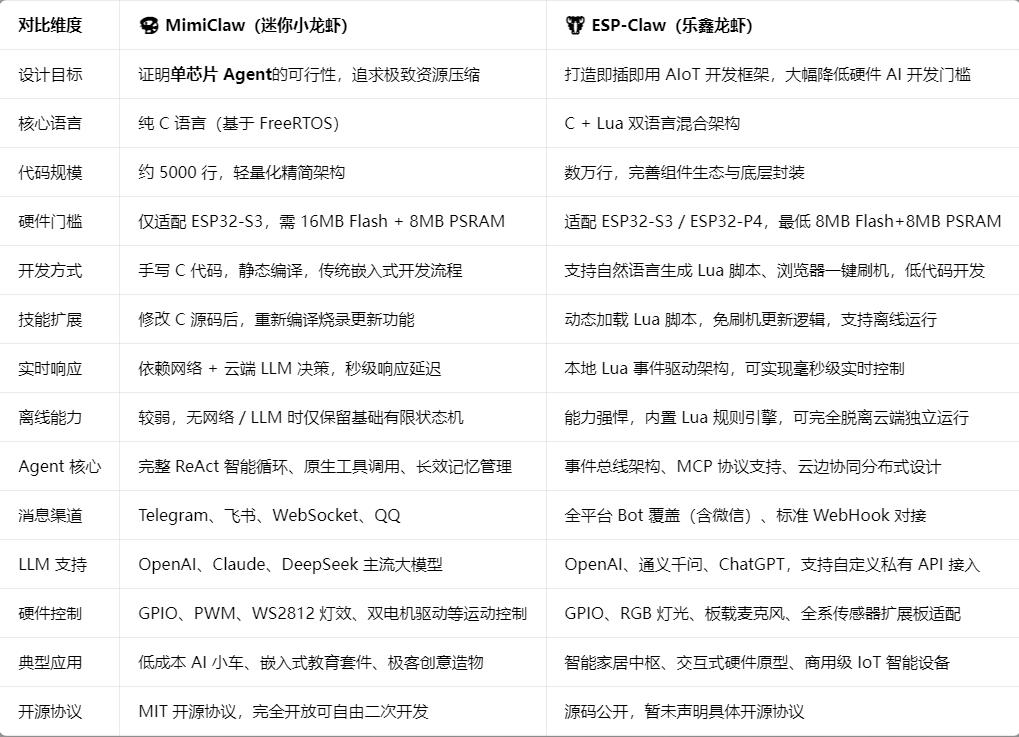 AI Visual Insight: This image corresponds to the framework comparison table. It typically presents dimensions such as language stack, runtime model, real-time performance, extensibility, and ecosystem integration, making it useful for fast technical preselection.
The first major difference appears in real-time control capability
MimiClaw is closer to an “LLM-driven embedded agent.” If critical actions depend on cloud inference, end-to-end response is usually in the 1-to-3-second range. That is acceptable for chat toys or demo robots, but it is not sufficient for obstacle avoidance, closed-loop control, or safety-critical actions.
ESP-Claw can execute event rules locally, so the path from sensor interrupt to action trigger can stay in the millisecond range. Even under unstable network conditions, lights, buzzers, threshold checks, and linkage rules can still operate. This is extremely important for product stability.
Different projects call for different architecture paths
If your goal is to learn low-level Agent implementation, study minimal runtime design, or optimize aggressively for cost and power consumption, MimiClaw is the better fit. It behaves like an executable textbook that lets you see exactly how context, planning, and tool invocation land inside an MCU.
If your goal is to deliver a demoable prototype within 48 hours, change business logic frequently, or support multi-device orchestration and MCP integration, ESP-Claw aligns better with engineering reality. Its value comes from reducing firmware change cost, not simply from minimizing code size.
# Simplified decision tree
if need_millisecond_response; then
  choose "ESP-Claw or a big-brain + little-brain layered architecture"
elif value_minimal_implementation_and_learning; then
  choose "MimiClaw"
else
  choose "ESP-Claw for rapid prototyping and cloud-edge collaboration"
fi
This decision logic helps you quickly determine whether your project is a better fit for the minimalist C path or the script-driven platform path.
Hybrid deployment will become the more common engineering answer
In complex robots, the best practice is often not choosing one over the other, but using layered coordination. A high-compute platform handles navigation, vision, and multimodal inference, while ESP32-S3 nodes manage expressions, buttons, servos, lighting, and local voice interaction.
In this model, either MimiClaw or ESP-Claw can serve as the “intelligent peripheral control layer.” The former emphasizes lightness and transparency; the latter emphasizes platformization and scripting agility. Each covers a different engineering radius.
The future direction is already clear
First, as small on-device models mature, Embedded AI Agents will move from “network-enabled intelligence” toward “native intelligence,” with more inference completed locally. Second, protocols such as MCP will standardize hardware capabilities, so devices will no longer act merely as peripherals. They will become tool nodes that LLMs can discover and invoke.
Third, minimalism and platformization will not replace each other. Low-cost toys, wearables, and educational devices need lightweight kernels like MimiClaw, while smart homes, industrial terminals, and operable commercial devices need manageable platforms like ESP-Claw.
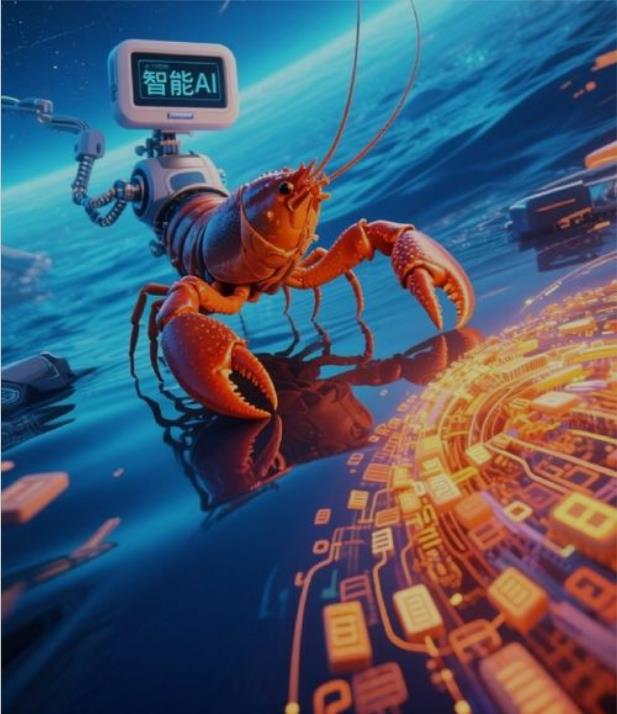 AI Visual Insight: Positioned at the end, this figure usually serves as a visual wrap-up of the solution and future outlook. It may use a robot prototype, board wiring, or a concept illustration to reinforce the core conclusion that low-cost chips can now host embodied intelligence.
FAQ
1. Why has the ESP32-S3 become a mainstream chip for Embedded AI Agents?
Because it strikes a strong balance across cost, power consumption, wireless connectivity, peripheral richness, and developer ecosystem support. For lightweight Agents, it is capable of handling message interaction, simple memory, tool invocation, and execution control.
2. Which should I learn first: MimiClaw or ESP-Claw?
If you care more about low-level principles and MCU-side implementation details, start with MimiClaw. If you want to build demoable intelligent hardware quickly and modify interaction logic frequently, start with ESP-Claw.
3. Do Embedded AI Agents have to stay online to work?
Not necessarily. Connectivity is often used for LLM inference and remote tool invocation, but local rules, sensor linkage, and part of lightweight decision-making can run offline. Truly stable systems usually adopt an “offline fallback + online enhancement” design.
Core Summary: This article systematically breaks down the three-layer architecture of Embedded AI Agents and focuses on two open-source approaches for ESP32-S3: MimiClaw and ESP-Claw. It compares their language stacks, real-time behavior, extensibility, and development efficiency, then offers architecture recommendations for prototype validation, hard real-time control, and cloud-edge collaboration.