[AI Readability Summary]
OpenClaw is a local-first agent runtime framework designed around a unified Gateway, multi-agent collaboration, tool permission filtering, and containerized sandbox execution. It addresses the engineering challenges of multi-platform integration, task decomposition, and secure tool invocation. Keywords: OpenClaw, SubAgent, Sandbox.
Technical Specifications Snapshot
| Parameter | Description |
|---|---|
| Project | OpenClaw |
| Language | TypeScript |
| Architectural Style | Gateway + Agent Loop + Tool Policy + Sandbox |
| Protocols / Interfaces | ChannelPlugin adapter interface, unified message channel |
| Runtime Model | Local-first, event-driven, multi-session |
| Core Dependencies | Docker Sandbox, tool registry, subagent registry |
| Repository | https://github.com/openclaw/openclaw |
| GitHub Stars | Not provided in the source material |
OpenClaw Uses the Gateway as the Central Control Plane
The key value of OpenClaw is not simply that it can call tools. Its real strength lies in turning agent identity, context, scheduling, security, and multi-platform access into a unified engineering runtime. The Gateway sits at the center of the system and handles message ingestion, format translation, dispatch, and output.
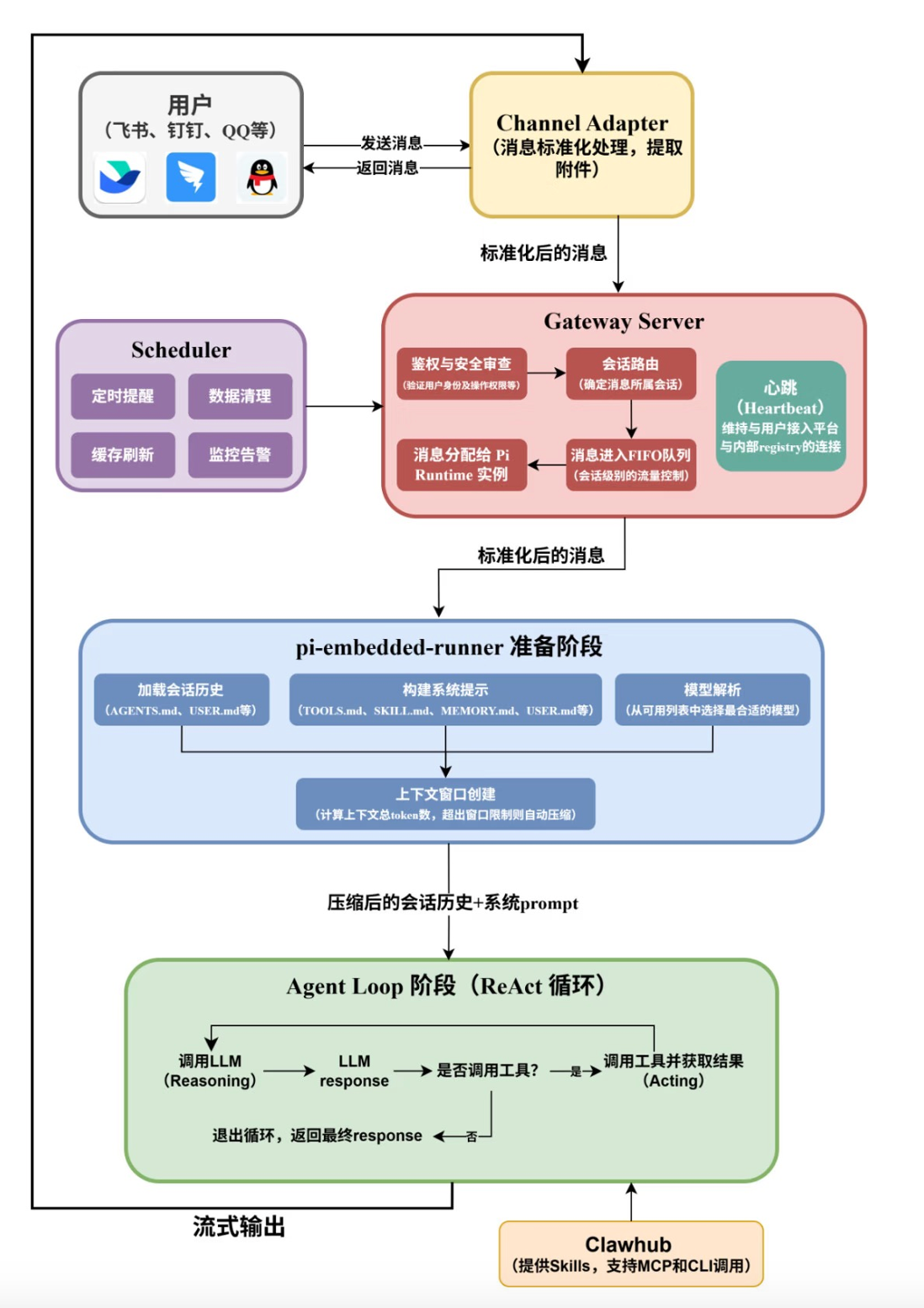
AI Visual Insight: This diagram illustrates OpenClaw’s centralized control structure. External messages first converge at the Gateway, then flow into the Agent Loop, tool layer, and security isolation layer. The design clearly emphasizes a unified entry point, centralized scheduling, and consistent permission boundaries, rather than tightly coupling each platform or agent directly to low-level execution capabilities.
OpenClaw also externalizes agent “personality and rules” into workspace Markdown files such as SOUL.md, AGENTS.md, TOOLS.md, and MEMORY.md. This approach transforms the prompt system from hardcoded logic into a hot-reloadable configuration layer.
Workspace Files Define Agent Identity and Behavior
These files are not injected into every run in exactly the same way. Bootstrap-class files enter the Project Context, BOOTSTRAP.md is used only during the first startup, MEMORY.md is injected as long-term memory, and finer-grained memory logs are recalled on demand through tools.
const bootstrapFiles = [
  "SOUL.md",      // Defines the agent's personality and values
  "AGENTS.md",    // Defines decision rules and workflows
  "TOOLS.md",     // Defines available resources and tool descriptions
  "MEMORY.md"     // Injects long-term memory
];

// Core idea: decouple identity, process, resources, and memory into the file system
for (const file of bootstrapFiles) {
  loadIntoProjectContext(file); // Load into the project context
}
This snippet captures OpenClaw’s core idea of assembling context through Markdown files.
The Tool System Uses Layered Abstractions to Reduce Model Invocation Complexity
OpenClaw divides tools into the Primitive Layer, Runtime Layer, and Official Surface. At the lowest level, it keeps only four general-purpose primitives: read, write, edit, and exec. This design lets the model rely on a small set of stable actions while still composing complex operations.
Four Primitives Form the Minimal Executable Surface
read retrieves information, write creates content, edit modifies existing objects precisely, and exec interacts with the external shell environment. Higher-level capabilities such as memory_search, cron, image, and tts are built on top of these primitives or runtime wrappers.
type PrimitiveTool = "read" | "write" | "edit" | "exec";

function dispatchTool(tool: PrimitiveTool, input: string) {
  // Uniformly dispatch the four foundational actions
  return runtime.execute(tool, input);
}
This code shows that OpenClaw prefers to use a small number of stable primitives to support higher-order automation capabilities.
The Gateway Uses the Adapter Pattern to Extend Multi-Platform Integration
Each platform only needs to implement a ChannelPlugin interface to translate message formats from Telegram, Slack, WhatsApp, and other channels into a unified internal structure. When adding a new channel, developers do not need to modify the agent’s core logic. They only need to extend the edge adapter layer.
This means OpenClaw’s extensibility comes primarily from protocol decoupling, not from inserting platform-specific conditionals into the core execution path. That distinction is critical for enterprise scenarios that integrate multiple customer service systems or social messaging entry points.
The Execution Path Emphasizes Iterative Reasoning and Security Guardrails
Based on the source material, the complete execution path is: a user message enters the Gateway, passes through a message loop to avoid concurrency confusion, moves into the prompt system to assemble context, then enters the Agent Loop for reasoning, tool selection, and iterative result generation. All tool calls ultimately pass through Sandbox boundary checks.
User message -> Gateway -> Message Loop -> Prompt System -> Agent Loop
-> Sandbox -> Tool System -> Agent Loop -> Gateway -> User response
This flow reflects OpenClaw’s core principles: unified input, iterative decision-making, and least-privilege execution.
The SubAgent Mechanism Is Essentially a Recoverable Task Delegation System
SubAgent is the core of OpenClaw’s multi-agent collaboration model. The parent agent packages a subtask into SpawnSubagentParams and hands it to the registry. The registry starts an independent session, executes the task, and returns the result to the parent session through an announce queue after completion.
It supports two runtime modes: run for one-off tasks and session for persistent multi-turn collaboration. Context handling is split into isolated and fork strategies. The former fully isolates execution, while the latter inherits the parent context and then branches from it.
The Registry Tracks the Full Lifecycle of a SubAgent
The core state of a subagent is stored in SubagentRunRecord. Its fields cover the requester, child session, task text, timeout control, frozen results, attachment directories, and callback retries. This gives the scheduler enough information to handle timeouts, orphan recovery, and cleanup.
type SubagentRunRecord = {
  runId: string;                  // Unique ID of the subtask
  childSessionKey: string;        // Child agent session identifier
  requesterSessionKey: string;    // Parent agent session identifier
  task: string;                   // Subtask content
  spawnMode?: "run" | "session"; // Runtime mode
  outcome?: "ok" | "error" | "timeout" | "killed"; // Final result
  frozenResultText?: string | null; // Result snapshot
  announceRetryCount?: number;    // Number of callback retries
};
This definition shows that a SubAgent is not just “spawning a thread.” It is a traceable task unit with explicit state governance.
The Tool Filtering Pipeline Shifts Permission Control Forward into the Policy Layer
OpenClaw does not expose every tool to every agent by default. Instead, it progressively narrows the available tool set through a multi-stage pipeline, including a global profile, provider-specific configuration, a global allowlist, agent-specific allowlists, and group-level policies.
This design prevents a general-purpose agent from accidentally gaining access to high-risk capabilities such as exec or write operations. It also makes it easier to tailor tool access by model provider and by agent role.
The Policy Steps Narrow Permissions Layer by Layer Instead of Expanding Them
In the source code, the ordering generated by buildDefaultToolPolicyPipelineSteps() is critical: profile first, then provider, then global, then agent, and finally group. Permissions are progressively filtered, not incrementally added.
const pipelineSteps = [
  "tools.profile",                    // Global capability tier
  "tools.byProvider.profile",         // Select tier by model provider
  "tools.allow",                      // Global allowlist
  "tools.byProvider.allow",           // Provider allowlist
  "agents.{agentId}.tools.allow",     // Agent-specific allowlist
  "agents.{agentId}.tools.byProvider.allow",
  "group tools.allow"                 // Group-level allowlist
];
This snippet shows that OpenClaw’s tool authorization model is a declarative filtering funnel.
The Sandbox Isolates High-Risk Tool Execution Inside the Docker Boundary
The Sandbox is the security foundation of OpenClaw. Its goal is not to enhance tool functionality, but to constrain the reachable execution boundary of operations such as exec, read, write, and edit, preventing the agent from running directly on the host machine without restrictions.
This is especially important for coding and automation workloads. The stronger the model becomes, the more important it is to define clear execution boundaries. By choosing Docker as the isolation layer, OpenClaw effectively governs both what the agent can do and where it can do it.
This Architecture Fits Production-Grade Agent Systems
Taken together, OpenClaw’s strengths do not come from a single algorithmic breakthrough, but from system composition: the Gateway standardizes integration, workspace Markdown files enable hot-reloadable identity, SubAgents handle task decomposition, Tool Policy enforces least privilege, and the Sandbox provides execution isolation.
This architecture is well suited for agent products that require long-running sessions, cross-platform integration, and auditable tool usage, rather than one-off demo bots.
FAQ
What fundamentally distinguishes OpenClaw SubAgents from ordinary multithreaded tasks?
SubAgents are more than concurrent execution units. They include independent sessions, context strategies, lifecycle records, result callbacks, and timeout recovery mechanisms. In practice, they behave more like governable child agents than raw threads.
What is the core benefit of the tool filtering pipeline?
It moves permission control forward into a declarative policy layer. That makes it possible to narrow tool availability step by step across the global scope, model provider, agent type, and group level, significantly reducing the risk of high-impact tool misuse.
Why does OpenClaw emphasize a Sandbox instead of letting agents call host machine commands directly?
Because exec, file reads and writes, and patch operations all carry significant destructive potential. The Sandbox uses Docker to establish a security boundary, limiting tool capabilities to a controlled container environment and making auditing, rollback, and permission isolation much easier.
References
- https://github.com/openclaw/openclaw
- In-Depth Understanding of the OpenClaw Technical Architecture and Implementation Principles (Part 1)
- In-Depth Understanding of the OpenClaw Technical Architecture and Implementation Principles (Part 2)
- https://github.com/xianyu110/awesome-openclaw-tutorial#
Core Summary: This article reconstructs the core OpenClaw architecture, focusing on the Gateway control plane, the SubAgent task delegation mechanism, the tool filtering pipeline, and the Docker Sandbox security boundary, helping developers quickly understand its multi-agent runtime model and extensible design.