This article focuses on the core AI developments of April 22, 2026: OpenAI’s first formal economic policy proposals, including a robot tax and a public wealth fund; Public.com bringing agents into regulated financial trading; and major updates across open-source models, video generation, and speech recognition. Keywords: OpenAI, agents, open-source models.
Technical Specifications at a Glance
| Parameter | Details |
|---|---|
| Content Type | AI industry daily brief / technical intelligence reconstruction |
| Core Topics | AI economic policy, financial agents, open-source models, AIGC applications |
| Languages Covered | Primarily English-language news with Chinese analysis |
| License / Copyright | Original content declared under CC 4.0 BY-SA |
| Star Count | Not a code repository; not provided |
| Core Dependencies | OpenAI, Anthropic, Google Gemma, Tencent Agent, Fun-ASR |
This daily brief shows that AI is shifting from model competition to institutional competition
The most valuable signal in the source material is not any single product launch. It is the fact that the AI industry is now influencing policy, capital, and regulation at the same time. OpenAI is no longer talking only about model capabilities. It is directly discussing a robot tax, a public wealth fund, and new labor structures.
This means AI companies have evolved from technology providers into participants in rulemaking. For developers and enterprises, future competition will not depend only on inference cost, context length, and model quality. It will also depend on compliance capabilities, interfaces for social governance, and depth of industry integration.
Key Signal 1: OpenAI is pushing AI into the macroeconomic policy layer
On April 21, OpenAI released a systematic set of economic policy recommendations centered on a robot tax, a public wealth fund, and a four-day workweek. This was not a routine PR move. It was a clear policy position.
From an industry perspective, this shows that leading model companies now recognize AI’s spillover effects on employment structures, wealth distribution, and national competitiveness. Technical roadmaps are expanding into institutional design, and policy discussion will become a new variable in AI deployment.
policy_points = [
    "机器人税",      # Fiscal adjustment for the displacement effects of automation
    "公共财富基金",  # Return part of AI-generated gains to society
    "四天工作周"     # Adapt labor systems to higher productivity
]

for item in policy_points:
    print(f"关注政策议题: {item}")  # Output the core policy directions
This code snippet abstracts the three core pillars of OpenAI’s policy proposal in the simplest possible form.
Financial services are becoming a high-intensity proving ground for agent commercialization
Public.com becoming the first agent brokerage was the day’s most consequential industry story. The significance is not that yet another company adopted agents. The significance is that agents entered a financial trading environment defined by heavy regulation, high risk, and clear accountability.
Once agents can participate in investment decisions and trade execution in regulated markets, the industry will rapidly shift its attention to three issues: decision explainability, accountability boundaries, and real-time risk control. These capabilities will become infrastructure for general-purpose agents.
Key Signal 2: Agents are moving from assistants to executable actors
In the past, most agents remained limited to low-risk tasks such as customer service, shopping, and information orchestration. Public.com’s move signals that agents are beginning to take on roles closer to true intermediaries. Their output is no longer just advice. It may directly influence capital flows.
For developers, this will drive a new class of requirements: audit logs, strategy replay, permission tiers, anomaly circuit breakers, and cross-model validation. Finance is not the end state. It is the starting point for compliant agent engineering.
def agent_trade_guard(signal, risk_score):
    if risk_score > 0.7:
        return "阻止交易"  # Trigger a circuit breaker when risk is high
    return f"执行策略: {signal}"  # Allow execution when risk is under control

result = agent_trade_guard("买入ETF", 0.35)
print(result)
This snippet shows the minimum risk-control gate that a financial agent must implement.
Open-source models and application-layer products are accelerating in parallel
Beyond policy and finance, another clear theme in the daily brief is the combination of open foundation models and rapid application-layer growth. Google Gemma 4 was released under the Apache 2.0 license across multiple parameter sizes, further lowering the barrier for enterprises building AI in-house.
At the same time, Tencent launched its consumer-facing agent globally, ByteDance advanced video generation with Seedance 2, and Fun-ASR 1.5 strengthened multilingual speech recognition. Together, these moves show that Chinese vendors are shifting competitive focus toward closed-loop scenarios rather than pure parameter races.
Open source and productization now form a dual-engine strategy
Gemma 4’s value lies in its commercial friendliness. It gives enterprises more flexible deployment options: local inference, private customization, or both. That makes it attractive for teams with strict requirements around data sovereignty and cost control.
Tencent, ByteDance, and Fun-ASR also show that the AI battleground of 2026 has shifted from who can generate content to who can embed capabilities into real business workflows. Agents, video generation, and speech recognition are all moving closer to production systems.
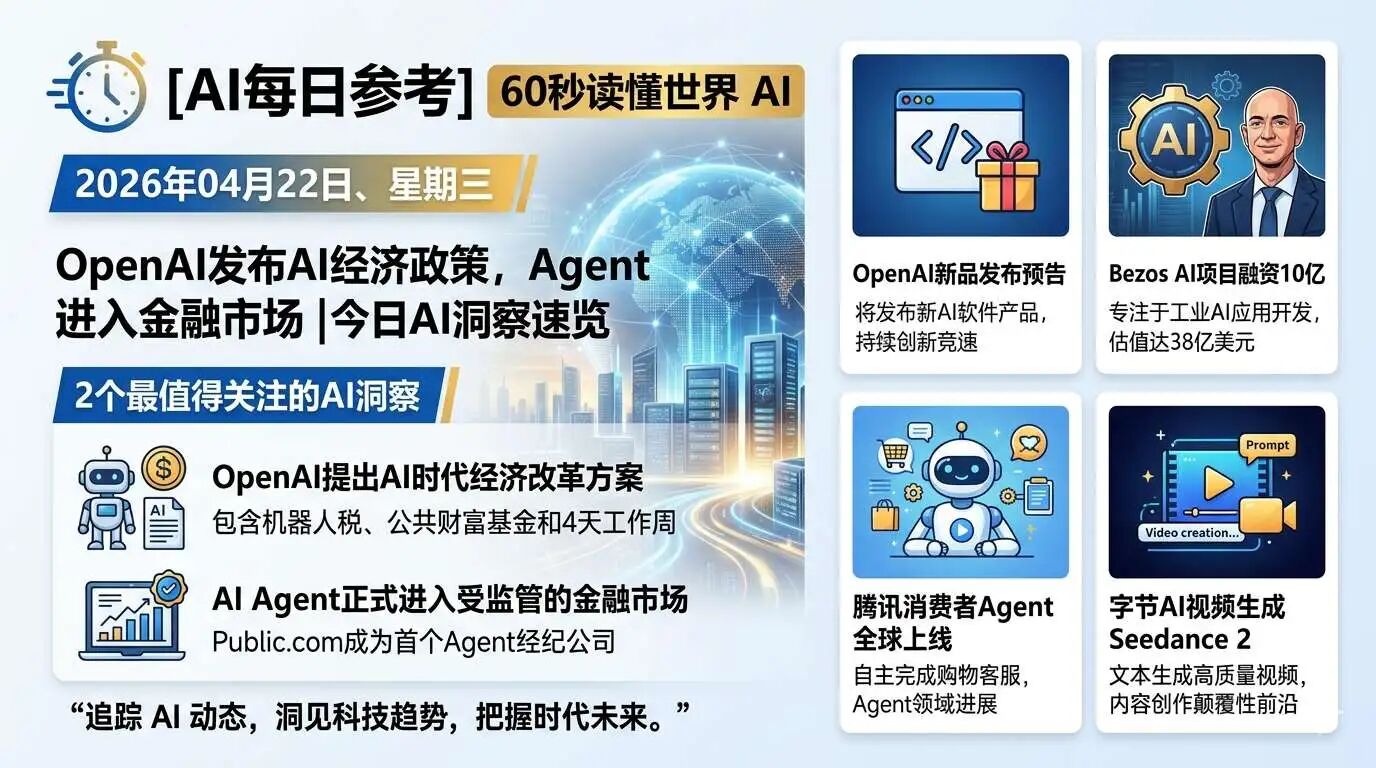
AI Visual Insight: This image serves as the thematic visual for the daily brief and is typically used to reinforce the sense of aggregation around the day’s most important AI developments. Its purpose is not to showcase a specific product interface, but to convey the nature of technical intelligence itself: multiple events happening in parallel, high information density, and the need for rapid filtering.
Capital flows and M&A show that the AI industry has entered a phase of structured consolidation
Project Prometheus raised $1 billion, and SoundHound AI acquired LivePerson. These developments show that capital is still heavily committed to AI, but funding is shifting away from broad narratives and toward vertical industries and platform consolidation.
Large industrial AI rounds suggest that investors are now betting on high-barrier, long-cycle, deeply embedded applications. Meanwhile, acquisitions in conversational platforms indicate that competition at the application layer has entered a consolidation phase, making it increasingly difficult for single-point capability companies to break out independently.
Developers should focus less on the news itself and more on capability migration paths
If you are building AI products, the immediate takeaway from today’s intelligence is clear: prioritize auditable agents, privatizable model stacks, and multimodal capabilities that close real business loops. The window for single-point demos is closing quickly.
If you are driving AI adoption inside an enterprise, your priorities should be different but related: choose open-source models carefully, establish risk tiers, define clear human-in-the-loop boundaries, and only then decide whether to place agents into trading, customer service, operations, or content production workflows.
The conclusion is now clear: AI is entering a phase of institutionalization and industry-specific deployment at the same time
The day’s ten major updates can be summarized into four themes: policy spillover, financial deployment, open-source diffusion, and application integration. Together, they show that AI is moving from whether it can be done to where it should be deployed, who is accountable, and how it can scale.
For technical teams, the truly scarce capability is no longer just calling model APIs. It is operating models reliably inside constrained environments. The highest-value teams in the future will be the ones that understand not only models, but also regulation, workflow design, and system governance.
FAQ
1. Why should developers care that OpenAI proposed economic policy recommendations?
Because it shows that AI is no longer only an R&D issue. It now affects taxation, employment, and industrial governance. Developers will need to consider compliance, auditability, and social impact much earlier in system design.
2. What does it mean that Public.com became an agent brokerage?
It means agents have entered a regulated financial environment for the first time. The evaluation standard is shifting from whether an agent can complete a task to whether it is explainable, accountable, and controllable from a risk perspective. That change will feed back into general-purpose agent architecture.
3. How should we interpret updates such as Gemma 4, Tencent Agent, and Fun-ASR 1.5?
Together, they show that AI is advancing along two tracks at once: foundation models are becoming more open, while application capabilities are becoming more productized. For most enterprises, the best strategy is not choosing one over the other, but combining an open-source foundation with scenario-specific packaging.
AI Readability Summary: This article reconstructs the key AI developments of April 22, 2026, with a focus on OpenAI’s first systematic economic policy proposals, Public.com becoming the first agent brokerage, and major updates from Tencent Agent, Gemma 4, Seedance 2, and Fun-ASR 1.5. It helps developers quickly understand four major themes: policy, capital, open source, and applications.