[AI Readability Summary]
The WGFACS throttle valve is an intelligent shielding gas control device for Panasonic welding robots. Its core value lies in dynamically adjusting gas flow based on welding current, enabling 40%–60% gas savings without modifying the original robot program or gas line architecture, while maintaining stable weld quality. Keywords: Panasonic welding robot, shielding gas savings, on-demand gas supply.
Technical specifications provide a quick snapshot
| Parameter | Description |
|---|---|
| Applicable scenario | Shielding gas control for Panasonic welding robots |
| Control basis | Real-time welding current changes |
| Communication method | Built-in Panasonic robot-specific communication protocol |
| Deployment method | Installed inline with the existing shielding gas pipeline |
| Program changes | No modification to the original robot program required |
| Gas line changes | No reconstruction of the existing gas line structure required |
| Energy-saving effect | 40%–60% reduction in shielding gas consumption |
| Response characteristics | Millisecond-level coordinated adjustment |
| Core dependencies | Flow sensing components, control module, standard quick-connect fittings |
| Article type | Technical analysis of industrial automation equipment |
The value of the WGFACS throttle valve lies in replacing coarse gas delivery with real-time on-demand supply
Panasonic welding robots are widely used in arc welding applications, but shielding gas delivery has long suffered from two typical issues: fixed high-flow supply causes waste, and gas flow that does not match welding conditions can affect weld stability.
The WGFACS throttle valve does not target general-purpose gas delivery. Instead, it is designed for dynamic condition control during robotic welding. Its logic is straightforward: when current rises, gas flow increases accordingly; when current drops, flow decreases in sync; when welding stops, only a standby threshold flow remains.
The device establishes a closed-loop gas control process through current signals
The device communicates directly with the Panasonic welding robot control cabinet and retrieves key parameters from the welding process in real time. Because current directly affects molten pool temperature, size, and shielding requirements, it becomes the most critical control input for the throttle valve.
Welding current rises  -> Molten pool volume increases -> Shielding demand increases -> Throttle valve raises flow
Welding current drops  -> Molten pool volume decreases -> Shielding demand decreases -> Throttle valve lowers flow
Current returns to 0   -> Non-welding state            -> Maintain slight positive pressure -> Throttle valve enters standby
This flow illustrates that the core of WGFACS is not “fixed gas saving,” but rather “condition-driven precision gas delivery.”
The WGFACS throttle valve is deeply adapted to Panasonic robot communication protocols
Unlike ordinary gas-saving devices, WGFACS is not an external mechanical flow restrictor. It is designed around the control characteristics of Panasonic welding robots. Its value lies in fitting existing production rhythms rather than forcing the production line to adapt to the device.
It includes a Panasonic robot-specific communication protocol, allowing seamless integration with the control cabinet while reducing secondary development work and on-site commissioning costs. For manufacturers, this means a lower deployment threshold, less retrofit risk, and more controllable downtime.
A typical integration model can be abstracted as the following structure
class WGFACSController:
    def adjust_flow(self, weld_current: float) -> str:
        # If current is zero, the robot is in a non-welding state
        if weld_current == 0:
            return "Standby micro-flow"
        # Under high-current conditions, increase shielding gas flow to cover a larger molten pool
        if weld_current > 220:
            return "High flow"
        # Under medium- or low-current conditions, reduce flow on demand to avoid waste
        return "Matched flow"
This illustrative code expresses the basic control principle of WGFACS: it uses welding current as the trigger variable for real-time flow tiering.
The standby strategy during non-welding intervals further amplifies energy-saving gains
In actual production, torch cleaning, workpiece flipping, path calibration, and station switching all create frequent non-welding intervals. Traditional solutions often maintain relatively high flow output during these periods, which is a major source of shielding gas waste.
WGFACS can detect a zero-current signal and reduce flow to a standby threshold the moment welding stops, retaining only a micro-flow to maintain positive nozzle pressure. This prevents backflow of air while also reducing idle gas consumption.
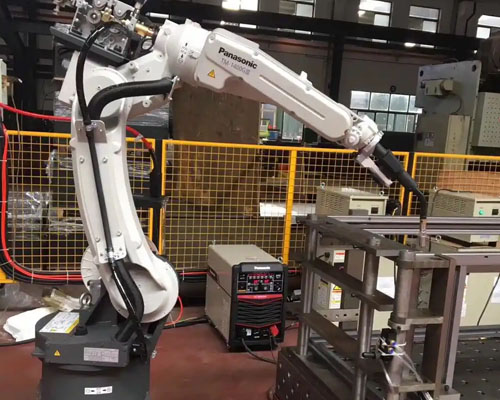 AI Visual Insight: The image shows an industrial gas-saving control device already integrated into an on-site gas line. The main unit appears as a hardware module installed near the welding station and includes a control box, connecting lines, and interface components. Visually, its working position can be inferred to be close to the shielding gas supply path, emphasizing the engineering characteristic of inline integration without interrupting the original system. This reflects a design optimized for rapid production-line retrofits rather than full-line replacement.
Millisecond-level recovery ensures savings do not come at the expense of takt time
When the robot restrikes the arc and welding current returns to normal, the throttle valve can restore gas flow within milliseconds, allowing the shielding gas envelope to quickly recover to the level required by current conditions. This capability determines that the device not only saves gas, but also avoids slowing production takt time.
def on_current_change(current: float):
    # Enter standby when current returns to zero to avoid continuous gas use during non-welding phases
    if current == 0:
        flow = "standby"
    else:
        # Restore the matched flow according to the current welding state
        flow = f"match_{current}_level"
    return flow
This code simulates the switching logic from welding stop to welding restart, reflecting the device’s fast response to welding takt time.
The solution applies to multiple materials and process scenarios
Panasonic welding robots commonly handle carbon steel, high-strength steel, aluminum alloy, and other materials. Different materials require different shielding gas types, flow rates, and stability levels. With traditional manual adjustment, excessive flow, insufficient flow, or delayed switching can easily occur.
WGFACS can maintain an appropriate flow strategy according to preset process requirements, reducing the need for frequent manual intervention. This is especially important in high-mix, low-volume production, where frequent process switching often leads to more waste and a higher probability of error.
Low intrusion and easy maintenance are the key priorities in on-site deployment
The device uses a modular design and standardized quick-connect fittings, allowing it to be installed directly inline with the existing shielding gas pipeline. One end connects to the gas cylinder regulator, and the other connects to the welding torch gas line. After basic training, operators can complete installation and commissioning.
Routine maintenance focuses on three items: verify monitoring parameters before operation, check for interface leakage and connection stability, and clean spatter and dust regularly. If the flow sensing components are calibrated quarterly, control accuracy can be maintained over the long term.
# Recommended daily inspection checklist
1. Check whether any interfaces are leaking gas
2. Check whether monitoring parameters are abnormal
3. Clean surface spatter and dust
4. Confirm that cooling vents are unobstructed
5. Calibrate flow sensing components quarterly
This checklist summarizes the minimum maintenance requirements for stable WGFACS operation in a factory environment.
This type of throttle valve represents an intelligent upgrade for welding gas control
The significance of WGFACS goes beyond saving shielding gas. It brings auxiliary welding equipment into a real-time control system. By using current signals to drive gas supply strategy, it balances weld quality, energy consumption, and maintenance convenience.
For enterprises that rely on Panasonic welding robots for large-scale production, the benefits of this type of solution typically appear in three dimensions: direct reduction in gas procurement costs, fewer welding defects caused by unstable gas supply, and a higher level of production standardization.
FAQ
Q1: Does the WGFACS throttle valve require modifications to the original Panasonic robot program?
A1: No. According to the source material, the device can directly adapt to the Panasonic control cabinet and the existing gas line without modifying the robot program or reconstructing the gas path, making it suitable for low-risk deployment.
Q2: Why use welding current as the basis for shielding gas regulation?
A2: Because welding current directly determines molten pool temperature and volume, which in turn affects shielding gas demand. Using current as the control input makes it possible to implement more accurate on-demand gas delivery: higher current requires more gas, and lower current requires less.
Q3: Will gas savings affect weld quality or arc-start stability?
A3: The premise of this solution is not to reduce flow indiscriminately, but to dynamically match actual operating conditions. It provides matched flow during welding, retains slight positive pressure when welding stops, and restores flow within milliseconds when welding resumes. The goal is therefore to preserve welding stability while improving energy efficiency.
Core Summary: This article reconstructs and explains the operating mechanism, communication adaptation, on-demand gas supply logic, and deployment and maintenance essentials of the WGFACS throttle valve in Panasonic welding robots. It shows how the device can reduce shielding gas consumption by 40%–60% and maintain stable weld quality without changing the original program or gas line architecture.