This article explains how to port pngquant 2.18.0 to the HarmonyOS/OpenHarmony PC platform with Lycium. The core challenge is that its handwritten configure script is not cross-dependency friendly, so you must explicitly export the pkg-config path and inject header and library paths. Keywords: Lycium, pngquant, OpenHarmony.
Technical Specifications Snapshot
| Parameter | Description |
|---|---|
| Project | pngquant 2.18.0 |
| Target Platform | HarmonyOS / OpenHarmony PC |
| Primary Languages | C, Shell |
| Build Method | Handwritten configure + make |
| License | GPL-3.0-or-later |
| Core Dependencies | libpng, zlib, lcms2, libimagequant |
| Target Architectures | armeabi-v7a, arm64-v8a |
| Key Framework | Lycium / tpc_c_cplusplus |
| Upstream Repository | github.com/kornelski/pngquant |
| Community Interest | The original article had about 190 views, 7 likes, and 6 bookmarks on CSDN |
pngquant Has Clear Value in HarmonyOS PC Scenarios
pngquant is a classic lossy PNG compression tool that fits asset size reduction, static resource preprocessing, and build pipeline optimization. For OpenHarmony, it is not a GUI component. It is a command-line tool that you can deploy directly.
Its porting value is not about whether it can compile once, but whether it can integrate reliably into Lycium’s dependency orchestration model. The real issues center on configure detection, pkg-config scope, and cross-toolchain variable propagation.
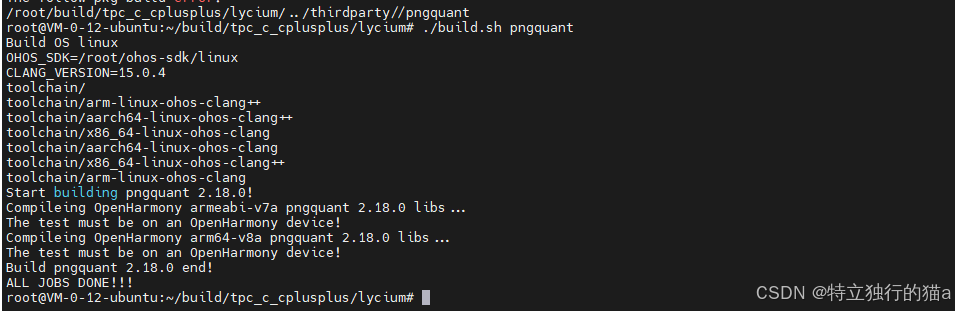 AI Visual Insight: The image is a placeholder illustration from the original CSDN article. Its main purpose is to introduce the pngquant porting workflow, usually in the context of cross-compilation, dependency adaptation, and script organization, rather than any runtime UI.
pngquant Is Not a Standard Autoconf Project, and You Must Confirm This First
Many third-party libraries in Lycium can reuse common GNU Autoconf practices, but the configure file in the pngquant 2.x root directory is a handwritten Bash script. It supports options such as --with-libpng, --extra-cflags, --extra-ldflags, and --disable-sse, but its detection logic depends much more heavily on explicit arguments.
This means that if you only set buildtools to configure without completing the dependency paths, the script can easily pick up libraries under the host machine’s /usr, or fail directly with libpng not found.
# First check which options the bundled pngquant configure script supports
./configure --help  # Confirm support for key options such as with-libpng and extra-cflags
This command helps you quickly verify that pngquant uses a handwritten configure entry point rather than a script generated by standard autotools.
Dependency Discovery in Lycium Must Be Explicitly Exported to Child Processes
Lycium assembles the dependency pkgconfigpath according to depends, but this only exists as a shell variable in the current process. If you do not export PKG_CONFIG_LIBDIR, the pkg-config child process invoked inside configure does not know where to find the cross-compiled libpng, zlib, and lcms2 packages.
This is the single most critical fact in this port: the issue is not whether the variable has a value, but whether child processes can inherit it. Many failed builds stop here.
zroot=$LYCIUM_ROOT/usr/zlib/$ARCH
pngroot=$LYCIUM_ROOT/usr/libpng/$ARCH
lcmsroot=$LYCIUM_ROOT/usr/lcms2/$ARCH

export PKG_CONFIG_LIBDIR="${pkgconfigpath}"  # Make the cross-dependency pkg-config path visible to configure child processes
This configuration passes the dependency information resolved by Lycium to the pngquant configure stage where it is actually needed.
pkg-config Alone Is Not Enough, and You Must Also Add -I and -L
pngquant’s lookup logic also scans default system directories, so in cross-compilation scenarios you should still pass --extra-cflags and --extra-ldflags explicitly. This ensures that header and library paths remain available even if the pkg-config metadata is incomplete.
This matters especially because libpng may use a layout such as include/libpng16, while lcms2 may provide lib64. For that reason, it is best to use [ -d ... ] checks before appending paths, so you do not pollute the compiler arguments.
extra_cflags="-Wno-unused-command-line-argument"
[ -d "${pngroot}/include" ] && extra_cflags="$extra_cflags -I${pngroot}/include"  # Add the libpng header path
[ -d "${pngroot}/include/libpng16" ] && extra_cflags="$extra_cflags -I${pngroot}/include/libpng16"  # Support the libpng16 directory layout
[ -d "${zroot}/include" ] && extra_cflags="$extra_cflags -I${zroot}/include"
[ -d "${lcmsroot}/include" ] && extra_cflags="$extra_cflags -I${lcmsroot}/include"
This script provides configure with stable, cross-platform header search paths.
HPKBUILD Organizes Source Retrieval, Environment Setup, and the Installation Prefix
In HPKBUILD, depends=("libpng" "zlib" "lcms2") tells Lycium to build the dependency libraries first. By contrast, makedepends should only include executable commands available on the host system, not library names. You must fetch the source with git clone -b $pkgver --recursive, or the libimagequant submodule will be missing.
At the same time, buildtools="configure" in Lycium routes the build through the configuredependpath branch and passes `–prefix=$LYCIUM_ROOT/usr/pngquant/