PostgreSQL is evolving from a traditional relational database into an open source data foundation for the AI era. The core gaps have been vector search, multimodal data management, and global collaboration infrastructure. HOW 2026 sends a clear signal: PGVector is maturing quickly, Chinese contributors are moving into core development, and PGNexus is beginning to support ecosystem governance and knowledge distribution. Keywords: PostgreSQL, PGNexus, PGVector.
Technical Specifications at a Glance
| Parameter | Details |
|---|---|
| Core Technologies | PostgreSQL, PGVector, IvorySQL, PGNexus |
| Primary Languages | C, SQL, PL/pgSQL, web platform technologies |
| Related Protocols / Interfaces | SQL, asynchronous I/O, vector search interfaces, community mailing list collaboration |
| Star Count | Not provided in the original source |
| Core Dependencies | PostgreSQL core, extension ecosystem, open source community governance, bilingual AI capabilities |
PostgreSQL Is Becoming the Default Open Source Foundation for AI Applications
The key message from HOW 2026 was not a routine panel discussion. It was a reaffirmation of PostgreSQL’s position in the ecosystem. Multiple speakers agreed that AI is pushing PostgreSQL from a general-purpose database toward a de facto open source AI database.
This definition does not come from branding. It comes from real-world workloads. RAG, long- and short-term memory for agents, and multimodal retrieval all require a database that combines transactions, extensibility, and vector capabilities. The performance evolution of PGVector fills in that critical piece.
-- Vector retrieval example: perform similarity search in PostgreSQL
SELECT id, content
FROM documents
ORDER BY embedding <-> query_embedding  -- Sort by vector distance; smaller distance means higher similarity
LIMIT 5;
This SQL snippet shows a typical way PostgreSQL supports semantic retrieval.
Community-Led Technical Evolution Is Directly Addressing High-Concurrency and Online Maintenance Pain Points
Two technical themes came up repeatedly during the panel: asynchronous I/O in PostgreSQL 18 and online tablespace maintenance in PostgreSQL 19. Together, they address the most practical enterprise concerns: higher performance and operations without downtime.
Asynchronous I/O matters directly for high-throughput read/write workloads because it improves I/O wait paths. Online tablespace maintenance reduces conflict between storage reorganization and production access. This means PostgreSQL is no longer just feature-rich. It is becoming better suited for production-grade mission-critical systems.
This Evolution Reflects PostgreSQL’s Engineering Maturity
In the next phase of database competition, success depends on more than feature count. It depends on maintenance windows, business continuity, and architectural elegance. PostgreSQL’s continued progress in these areas is a key prerequisite for its transition into an enterprise-grade AI data foundation.
features = {
    "pg18": ["async_io"],           # Improve I/O efficiency in high-concurrency read/write workloads
    "pg19": ["online_tablespace_maintenance"]  # Reorganize storage online and reduce business disruption
}
print(features)
This code snippet summarizes the two most closely watched features in a structured way.
A Healthy Community Continually Attracts Contributors and Closes the Governance Loop
The discussion offered a clear definition of a healthy community. It is not short-term momentum. It is the ability to continuously introduce new features, fix security issues, and keep growing even as core members rotate out. PostgreSQL stands out because of its open, inclusive, and highly collaborative operating model.
Visibility is a critical part of that model. Publishing contributor lists and publicly recognizing completed work may look like community etiquette, but in practice they are governance mechanisms that reduce collaboration silos and improve long-term contributor retention.
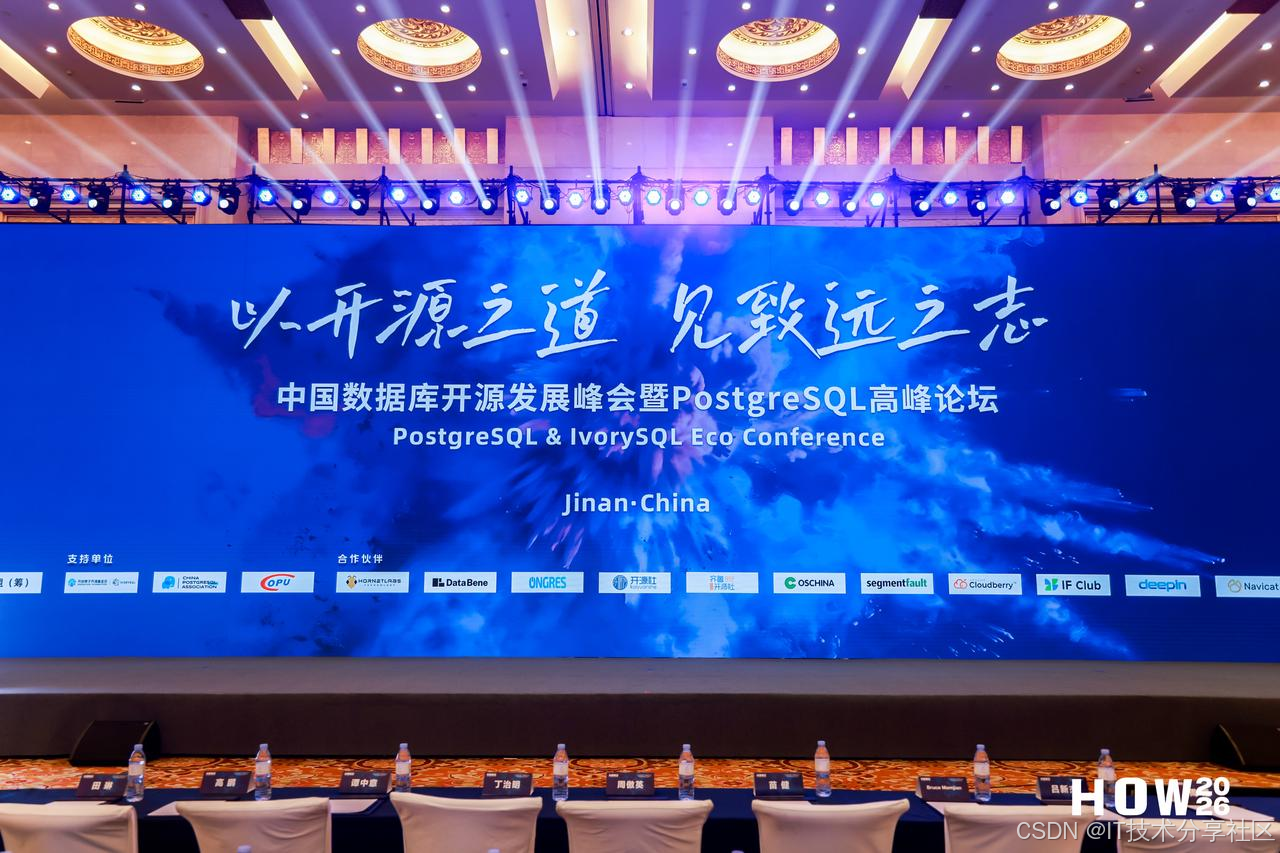 AI Visual Insight: This image shows the main visual design and stage environment of the HOW 2026 summit, including agenda information on a large screen, venue lighting, and event branding. It indicates that the event served as a formal launch and a cross-organization collaboration setting, functioning as offline infrastructure for PostgreSQL ecosystem governance, technical communication, and community connection.
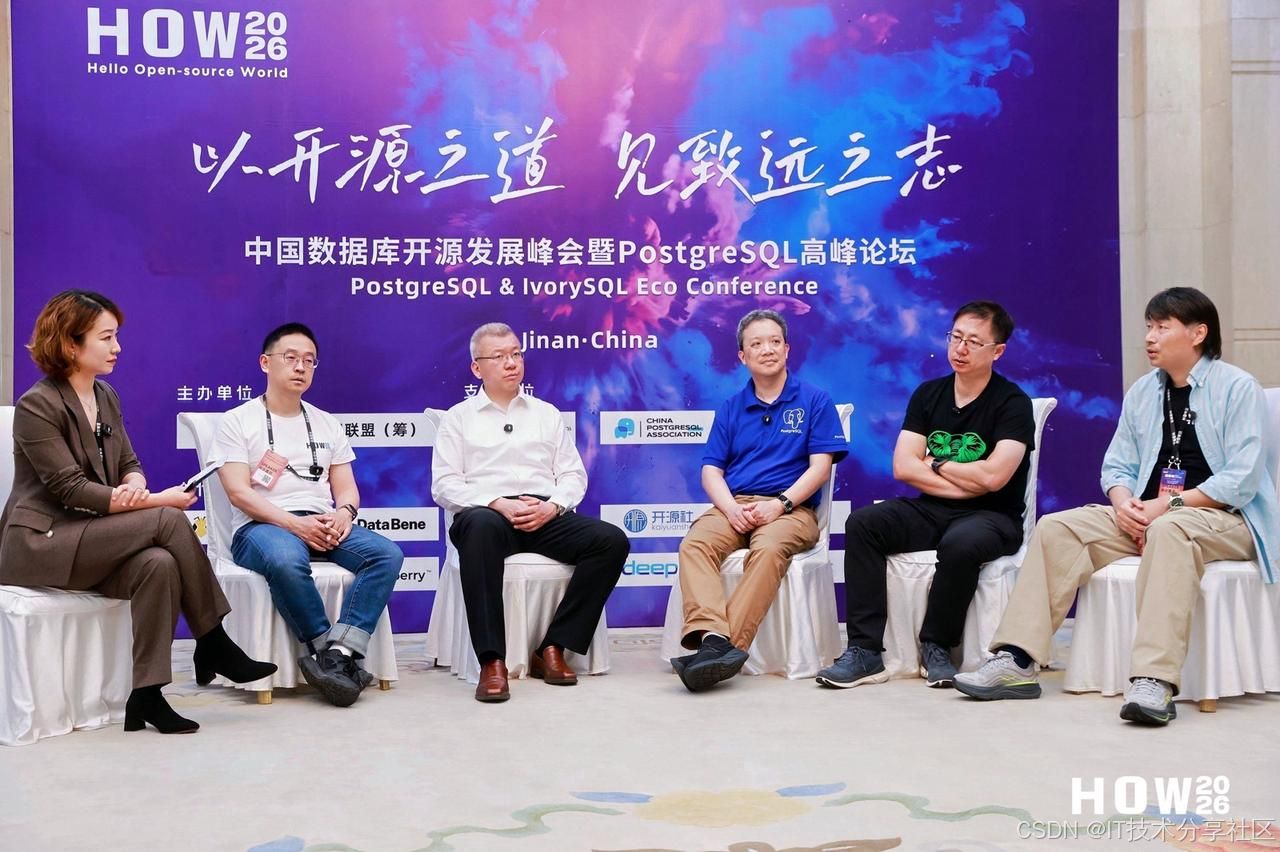 AI Visual Insight: This image captures the live panel discussion with multiple speakers on stage. It reflects how the PostgreSQL ecosystem is shifting from isolated technical announcements toward multi-stakeholder co-governance, including core contributors, enterprise executives, alliance organizers, and international advisors. It highlights the simultaneous integration of community governance, industry collaboration, and global perspective.
Chinese Contributors Are Moving from Participation to Core Leadership
One of the strongest signals from this discussion was the substantive impact of Chinese teams on PostgreSQL 19. The HighGo team contributed 45 engineers across the core, extensions, tools, and documentation. A high proportion of that work targeted the core itself, which shows that contribution priorities have moved into the most technically demanding layer.
More importantly, individual contributors are also beginning to receive positive feedback from the international community. New contributors are entering active contributor lists within a short period and are being invited to share their experiences at international conferences. That suggests Chinese developers are building a dual-track growth model that combines enterprise investment with individual advancement.
This Shift Will Change How the Global Community Sees China’s Role
In the past, outside observers often viewed Chinese companies primarily as PostgreSQL users or commercial integrators. Now that role is shifting toward feature co-builders, governance participants, and voices in international technical discussions. The long-term impact on the global ecosystem could be significant.
# A typical open source contribution path
subscribe mailing-list
read commitfest topics
submit patch
respond review
iterate until merged
This flow summarizes the typical PostgreSQL contribution path from observation to patch submission.
International Expansion Is Evolving from Market Entry to Digital Sovereignty Collaboration
The Middle East example discussed in the panel is particularly important. Saudi Arabia has explicitly allocated part of its IT budget to open source and is building a national open source repository. PostgreSQL is already entering that national-level field of view. This means PostgreSQL is no longer competing only with database products. It is also competing within national digital infrastructure strategies.
IvorySQL’s international collaboration offers further evidence that database forks and ecosystem platforms initiated in China now have the capacity to support cross-border R&D collaboration. Open source globalization is evolving from selling products to exporting collaboration models, which raises the long-term ceiling considerably.
PGNexus Is Filling a Long-Standing Infrastructure Gap in the PostgreSQL Ecosystem
If code contribution defines the depth of a community, PGNexus helps define the efficiency of community connection. It is not just a news portal. It is a unified entry point for knowledge aggregation, project insight, sandbox validation, bilingual support, and governance collaboration.
This kind of platform infrastructure is rarely built proactively by enterprises because the return is slow, its value is public, and both the technical and operational barriers are high. But once it takes shape, it can significantly improve how contributors discover information, validate ideas, and collaborate across regions.
platform_capabilities = [
    "knowledge_hub",      # Aggregate knowledge, updates, and project intelligence
    "sandbox_demo",       # Provide demo and validation environments
    "bilingual_ai",       # Use AI to provide bilingual support and reduce barriers to international collaboration
    "ecosystem_governance"# Support governance and coordination entry points
]
This code snippet summarizes the four platform capabilities that earned PGNexus strong praise.
Talent Alliances and Curriculum Systems Will Determine Contribution Scale Over the Next Three to Five Years
The formation of a database open source development alliance shows that ecosystem building is shifting from project-driven growth to talent-system-driven growth. Once university courses, scholarships, and enterprise practice pipelines connect, contributors no longer need to emerge purely from personal interest. The ecosystem can build a more stable talent supply.
This is especially important for PostgreSQL. Core database development has a high barrier to entry, a long learning curve, and a slow feedback cycle. Without alliances and education systems to support it, scaling the contributor base sustainably is difficult.
PostgreSQL’s Future Competitiveness Will Depend on Code, Governance, and Platforms at the Same Time
The final conclusion from HOW 2026 is clear: PostgreSQL’s next stage of competition is not only about core performance. It is a combined competition across code contribution, community governance, international collaboration, and platform infrastructure.
PGVector responds to AI demand. Asynchronous I/O and online maintenance address production requirements. Alliances address talent supply. PGNexus addresses global collaboration. These four tracks are converging toward the same outcome: pushing PostgreSQL closer to the center of global open source data infrastructure.
FAQ
Why is PostgreSQL being called an “open source AI database”?
Because it combines mature transactional capabilities with vector search support through extensions such as PGVector. That makes it capable of supporting RAG, agent memory, and multimodal data workloads within a unified data stack.
How is PGNexus different from a typical community portal?
PGNexus does more than aggregate news. It emphasizes project analysis, sandbox validation, AI-powered bilingual support, and governance entry points. In essence, it is infrastructure designed for global collaboration.
How can Chinese developers participate in the PostgreSQL community more practically?
A good starting point is the mailing list, CommitFest, documentation fixes, extension maintenance, and small patches. From there, contributors can gradually move toward core development. Enterprise support and university course systems are also reducing the cost of entry.
Core Summary
The HOW 2026 panel surfaced three major themes in the PostgreSQL community: AI-driven database capability upgrades, Chinese contributors moving rapidly onto the core stage, and the strategic emergence of PGNexus as a global collaboration hub. This article reconstructs those signals across four dimensions: technical evolution, community governance, internationalization, and talent development.