For production LLM environments, this guide distills six engineering capabilities you must put in place: rate limiting and graceful degradation, logging and observability, intelligent caching, multi-model backup, security auditing, and compliance. The core pain points are service instability, uncontrolled costs, difficult incident diagnosis, and exposed data risk. Keywords: LLM production, rate limiting, graceful degradation, compliance auditing.
Technical Specification Snapshot
| Parameter | Description |
|---|---|
| Language | Python |
| Protocols / Interfaces | HTTP APIs, asynchronous calls, streaming and non-streaming inference interfaces |
| GitHub Stars | Not provided in the source |
| Core Dependencies | asyncio, dataclasses, logging, json, hashlib, datetime |
| Target Scenarios | LLM gateways, AI assistants, RAG services, Agent platforms |
| Primary Goals | Stability, observability, cost control, security, and compliance |
Late-stage production issues determine the upper bound of an LLM system
Many teams assume the launch is complete once they connect a large model to an API. In reality, the most serious risks tend to surface under high concurrency, abnormal traffic, model instability, and audit traceability requirements. A demo that runs is not the same as a service that can be operated reliably.
Based on the original material, this article focuses on production capabilities six through ten and restructures them into a more implementation-friendly technical guide for engineering teams. You can think of it as the minimum production baseline for an LLM service gateway.
Request rate limiting must constrain request count, token usage, and user quotas at the same time
Rate limiting is not just QPS control. In LLM systems, both request volume and token consumption map directly to provider quotas, system throughput, and budget safety. At a minimum, you should implement three layers of control: global requests per minute, global tokens per minute, and per-user daily quotas.
from dataclasses import dataclass
from datetime import datetime, timedelta
from collections import deque

@dataclass
class RateLimit:
    requests_per_minute: int = 60
    tokens_per_minute: int = 90000

class SimpleRateLimiter:
    def __init__(self, limit: RateLimit):
        self.limit = limit
        self.req_times = deque()
        self.token_records = deque()

    def allow(self, estimated_tokens: int) -> bool:
        now = datetime.now()
        cutoff = now - timedelta(minutes=1)

        # Remove requests older than one minute
        while self.req_times and self.req_times[0] < cutoff:
            self.req_times.popleft()
        while self.token_records and self.token_records[0][0] < cutoff:
            self.token_records.popleft()

        recent_tokens = sum(tokens for _, tokens in self.token_records)

        # Validate both request count and total token usage
        if len(self.req_times) >= self.limit.requests_per_minute:
            return False
        if recent_tokens + estimated_tokens > self.limit.tokens_per_minute:
            return False
        return True
This code demonstrates a basic sliding-window rate limiting strategy and is well suited to evolve into a dual-layer quota model with both global and per-user controls.
The goal of graceful degradation is not prettier error messages, but uninterrupted business workflows
When the primary model times out, the provider returns HTTP 429, the budget ceiling is reached, or a user quota is exhausted, the system still needs to produce a predictable result. Degradation strategies generally fall into three categories: static fallback messages, backup models, and cache-based fallback.
A mature degradation layer should preserve error semantics such as “global rate limited,” “quota exhausted,” and “primary model unavailable.” That allows frontend applications and operations systems to handle each case differently instead of showing a generic “service unavailable” message for everything.
Observability must cover requests, responses, cost, and security events
The worst production incidents leave no trace. Without a trace_id, you cannot correlate a single conversation request across the gateway, model layer, cache layer, and audit layer. Structured logging is one of the lowest-cost, highest-return infrastructure investments you can make.
import json
import uuid
from datetime import datetime

def build_log(event_type: str, model: str, user_id: str, latency_ms: float, cost: float):
    log = {
        "trace_id": str(uuid.uuid4()),
        "timestamp": datetime.now().isoformat(),
        "event_type": event_type,
        "model": model,
        "user_id": user_id,
        "latency_ms": latency_ms,
        "cost": cost,
    }
    # Output structured JSON for easier search and aggregation in logging platforms
    return json.dumps(log, ensure_ascii=False)
The core value of this snippet is its unified log structure, which creates a solid foundation for later integration with ELK, Datadog, or Grafana Loki.
The image clearly highlights the observability module
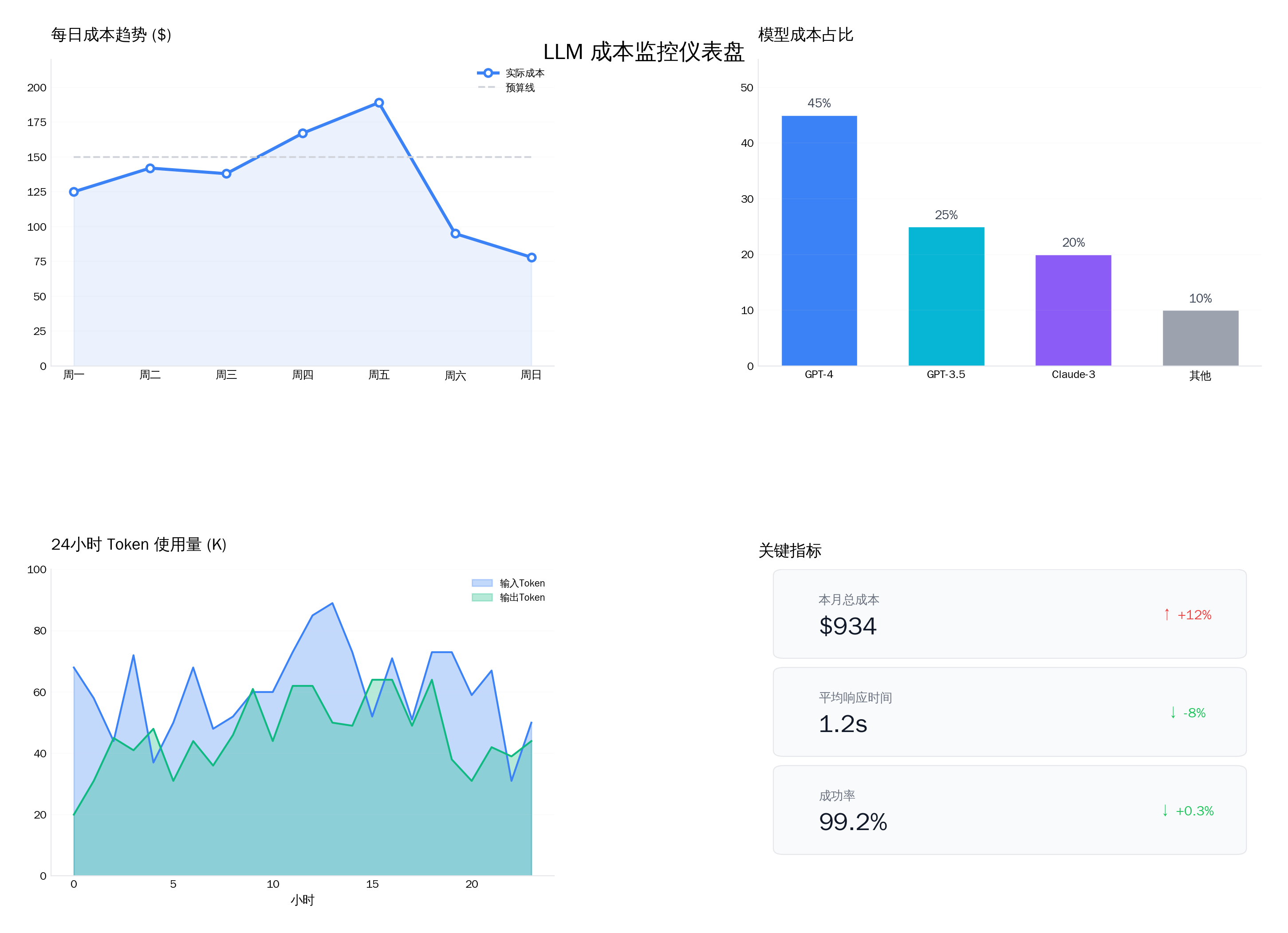 AI Visual Insight: This image appears in the “Logging and Observability” section and semantically corresponds to a monitoring dashboard or process diagram. It emphasizes that production systems need unified collection of request traces, error events, performance metrics, and audit information, highlighting the engineering shift from “being able to call a model” to “being traceable, analyzable, and alertable.”
Intelligent caching strategies directly affect both cost curves and response latency
Repeated calls for the same question are extremely common in LLM workloads. Without caching, the system keeps paying duplicate token costs for equivalent requests. At a minimum, your cache key should include the model name, message content, and any sampling parameters that influence the output.
import hashlib
import json

def make_cache_key(model: str, messages: list, temperature: float = 0.0):
    payload = {
        "model": model,
        "messages": messages,
        "temperature": temperature,
    }
    # Hash the normalized request to avoid duplicate model calls
    return hashlib.sha256(
        json.dumps(payload, sort_keys=True).encode()
    ).hexdigest()
This code generates a stable cache key and serves as the first step in building an LLM response cache.
Cache design must optimize not only hit rate, but also invalidation strategy
An in-memory cache alone is not enough. Production systems also need TTL policies, LRU eviction, model-level isolation, and bulk invalidation mechanisms for prompt template upgrades. If the business allows it, you can also extend the design with semantic caching to reuse answers for similar queries.
Multi-model backup is the last line of defense for AI service availability
A dependency on a single model passes external provider instability directly to end users. A production system should maintain at least one primary model, one lower-cost backup model, and one cross-provider model to mitigate quality, cost, and availability risks respectively.
models = [
    {"name": "gpt-4o", "priority": 1},
    {"name": "gpt-4o-mini", "priority": 2},
    {"name": "claude-3-sonnet", "priority": 3},
]

def pick_model(candidates):
    # Select the currently available model by priority
    return sorted(candidates, key=lambda x: x["priority"])[0]
This example demonstrates the simplest model routing concept. In real-world systems, you should also add health checks, failure counters, and timeout-based switching.
Failover mechanisms require state awareness rather than blind retries
If a model has already failed continuously, new requests should not continue to hit it. The correct approach is to track at least three states: healthy, degraded, and unhealthy. You should also define recovery thresholds to avoid instantly overwhelming a model the moment it comes back online.
Security auditing and compliance checks are now the entry barrier for enterprise AI
Once an LLM handles user conversations, support tickets, contracts, or medical text, the system enters a compliance-sensitive domain. At a minimum, you should implement four capabilities: request auditing, input/output hashing, sensitive data detection, and report generation.
import hashlib
import re

def classify_text(text: str) -> str:
    patterns = [r'\b1[3-9]\d{9}\b', r'[\w.-]+@[\w.-]+']
    # Mark the text as sensitive if it contains a phone number or email address
    return "confidential" if any(re.search(p, text) for p in patterns) else "internal"

def hash_text(text: str) -> str:
    # Store an audit fingerprint as a hash instead of keeping the raw text directly
    return hashlib.sha256(text.encode()).hexdigest()[:32]
This snippet reflects the core principles of compliance auditing: classify sensitivity, preserve traceable evidence, and minimize plaintext retention.
Launch checklists should be prioritized instead of treated with equal weight
P0 items must include prompt injection protection, timeout and retry handling, token limits, cost alerts, and error handling. P1 items should cover streaming optimization, request rate limiting, structured logging, caching, and model backup. P2 items include dashboards, capacity planning, and formal compliance reports.
An executable production baseline can be summarized in six principles
First, keep the service available before you optimize answer quality. Second, make every call traceable. Third, make every cost attributable. Fourth, make every high-risk input auditable. Fifth, ensure every cache has an invalidation strategy. Sixth, give every primary model a backup path.
If your LLM application already has these six capability groups in place, then it truly has the engineering foundation required to move from demo to production.
FAQ
FAQ 1: Why can’t traditional API rate limiting strategies be applied directly to LLM services?
Because LLM cost and system pressure come not only from request count, but also from token volume. The same 10 requests can consume vastly different resources if one carries long context windows. That is why token-based limiting must be added alongside request-based controls.
FAQ 2: Can caching make LLM responses outdated or inaccurate?
Yes. That is why the cache must be tied to the model version, prompt version, and TTL. For questions with highly time-sensitive knowledge, you should shorten expiration windows and, when necessary, cache only low-risk or standardized Q&A patterns.
FAQ 3: Should multi-model backup prioritize the same provider or a cross-provider option?
You need both. Switching within the same provider usually has lower migration cost and works well for routine degradation. A cross-provider model helps you survive platform-level outages and is better suited for disaster recovery. In production, the best practice is to maintain both layers of redundancy.
Core Summary
This article focuses on the late-stage capabilities required to move an LLM application from demo to production. It systematically breaks down six core modules: request rate limiting, graceful degradation, structured logging, intelligent caching, multi-model failover, and security and compliance auditing, and it provides practical Python implementation patterns and a launch readiness checklist.