This is a cathode copper robotic stripping system designed for copper electrorefining. Its core capabilities include dual-line parallel production, coordinated stripping with a peeling knife and dual-row suction cups, vision-based inspection and sorting, and MES data integration. It addresses the high labor intensity, quality instability, and high mother plate damage rates associated with manual stripping. Keywords: cathode copper stripping, robotic automation, machine vision.
The technical specifications of this solution can be summarized quickly.
| Parameter | Description |
|---|---|
| Application | Copper electrorefining, cathode starter sheet stripping |
| System configuration | Dual-line parallel setup with upper and lower two-level layout |
| Core execution units | Industrial robots, peeling knife mechanism, dual-row vacuum suction cups |
| Inspection capabilities | Surface defect vision inspection, weighing, sorting |
| Data interfaces | Supports production data collection and MES upload |
| Automation rate | More than 95% |
| Line takt time | ≤15 seconds/cycle |
| Key benefits | Intact rate ≥99%, mother plate damage rate <0.5% |
| Languages/Protocols | PLC control logic, Industrial Ethernet/fieldbus (model not specified in source) |
| GitHub stars | Not provided in the source; this is not an open-source industrial project |
| Core dependencies | Servo system, vacuum system, machine vision, weighing and conveying modules |
The core value of cathode copper stripping automation lies in stable quality and continuous production.
In the copper electrorefining process, cathode stripping connects upstream electrolysis with downstream processing. Traditional manual operations depend heavily on skilled workers, and fatigue, harsh environments, and process fluctuations can easily make stripping performance unstable. That directly affects starter sheet integrity and mother plate service life.
The solution provided by SNK is not a point replacement for a single machine. It is full-line automation covering cleaning, stripping, recovery, leveling, weighing, inspection, sorting, and boxing. Dual-line parallel production means that when one line is under maintenance, the other can continue running. That makes the system well suited for continuous manufacturing environments.
The system function chain forms a closed loop by connecting multiple modules.
| Module | Function |
|---|---|
| Incoming material cleaning | Automatic high-pressure water washing to remove residual liquid and sludge |
| Robotic stripping | Coordinated separation of the starter sheet using a peeling knife and suction cups |
| Empty mother plate recovery | Automatic stacking, palletizing, and recirculation after stripping |
| Starter sheet conveying | Automatic transfer to downstream processing stations |
| Leveling and weighing | Corrects deformation and records mass data |
| Inspection and sorting | Identifies cracks, holes, and edge damage, then grades parts |
| Boxing | Automatically palletizes qualified parts into boxes |
# Simplified process flow for a cathode copper stripping line
process = [
    "High-pressure washing",   # Remove electrolyte residue and reduce downstream interference
    "Robotic stripping",       # Peeling knife + dual-row suction cups perform core separation
    "Empty mother plate recovery",  # Recover mother plates and prepare them for reuse
    "Starter sheet leveling",  # Correct bending deformation
    "Weighing and recording",  # Capture traceability data
    "Vision-based sorting",    # Detect defects and classify automatically
    "Automatic boxing"         # Output to downstream operations
]

for step in process:
    print(f"Executing step: {step}")  # Drive the full-line sequence in order
This code expresses the end-to-end processing chain of the solution as a sequential workflow.
The difficulty of starter sheet stripping comes from the uncertainty of bonding force.
The source material clearly states that the bonding condition between the starter sheet and the mother plate is not stable. Influencing factors include electrolyte composition, temperature, current density, copper layer thickness uniformity, mother plate surface condition, and electrolysis cycle time. In other words, without adaptive capability, a fixed mechanical motion profile cannot cover all operating conditions.
If the system uses only vertical pulling, the stripping force becomes too concentrated in the vertical direction. That can easily cause starter sheet tearing, local deformation, and even mother plate damage. In industrial production, the real risk is not occasional slowdowns. It is batch-level instability.
The coordinated mechanism between the peeling knife and dual-row suction cups is the key to success.
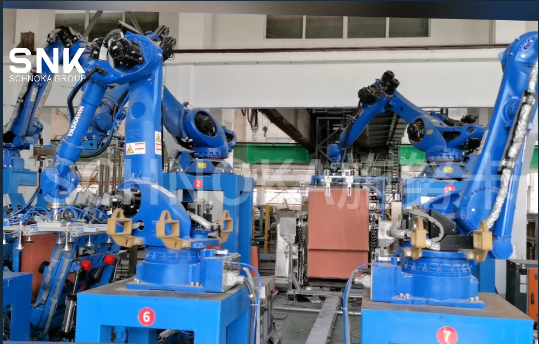 AI Visual Insight: The image shows the on-site structure of a cathode copper stripping mechanism. The core areas appear to be the peeling knife insertion point, the dual-row vacuum gripping end effector, and the workpiece positioning and clamping zone. This layout emphasizes a continuous motion chain from edge pre-separation to angled pull-off, indicating that the system does not rely on brute-force extraction. Instead, it reduces the risk of starter sheet tearing by controlling mechanical angle, suction sequence, and force path.
Its operating logic can be summarized in four steps: first, a specially designed peeling knife enters the edge gap at an angle; second, the first row of suction cups stabilizes the locally separated area; third, the second row creates a larger force-bearing area and applies angled pulling force; finally, servo control adjusts insertion depth, angle, and vacuum curve to complete flexible stripping.
def peel_control(resistance, vacuum, angle):
    # Adjust the stripping strategy based on resistance feedback
    if resistance > 0.8:
        angle += 3          # Increase the angle to reduce vertical tearing risk
        vacuum *= 0.95      # Slightly reduce vacuum to avoid sudden over-pulling
        speed = 0.6         # Lower speed to enable soft stripping
    else:
        speed = 1.0         # Maintain standard takt time when resistance is normal
    return angle, vacuum, speed
This code captures the core idea of adaptive stripping control: dynamically adjust angle, vacuum, and speed based on feedback.
Dual-line parallel production and layered layout improve capacity redundancy and floor-space efficiency.
This solution uses an upper-and-lower two-level spatial design. In essence, it compresses material flow paths and arranges processes in parallel within a limited workshop footprint. For smelting enterprises, this structure is often easier than a long single-level line when balancing throughput, maintenance, and future expansion.
More importantly, the two lines can operate independently. Equipment maintenance, tool changes, or faults on one line do not force a full-plant shutdown. This kind of redundancy-oriented automation aligns better with industrial ROI logic than simply chasing peak takt time.
The key metrics already show that this solution has real engineering value.
| Metric | Manual Stripping | SNK Robotic Stripping |
|---|---|---|
| Starter sheet intact rate | 92% – 95% | ≥99% |
| Single-cycle stripping takt time | 20 – 30 seconds | ≤15 seconds |
| Mother plate damage rate | About 5% | <0.5% |
| Average daily throughput (single line) | About 800 sheets | ≥1200 sheets |
| Quality consistency | Depends on operator skill | Programmatically consistent |
The data shows that the system is not only faster, but also more stable. For copper smelters, intact rate and mother plate damage rate often have a more direct effect on total cost than takt time alone.
The benefits of this production line go beyond labor reduction to a traceable manufacturing upgrade.
The labor figures in the original material are straightforward: traditionally, each line requires 6-8 operators, or about 12-16 people across two shifts. After automation, each line needs only 1-2 inspection personnel, reducing labor by more than 80%. At the same time, workers are moved away from high-temperature areas, acid mist, and heavy manual work, significantly lowering occupational health risks.
Once weighing, inspection, sorting, and MES upload are integrated, the system no longer outputs only copper sheets. It outputs production records with complete process data. That enables quality traceability, anomaly analysis, and process optimization, creating long-term data assets.
record = {
    "line_id": "L1",                # Line identifier
    "weight": 52.4,                  # Starter sheet weight
    "defect": "none",              # Vision inspection result
    "peel_resistance": 0.63,         # Stripping resistance feedback
    "quality_grade": "A"           # Automatic grading result
}

# Perform minimal data packaging before uploading to MES
payload = f"{record['line_id']}|{record['weight']}|{record['quality_grade']}"
print(payload)
This code shows how the production line can convert operation results into traceable data objects.
The reasons to choose this solution come down to industry fit, mechanism design, and full-line integration capability.
First, this is not a generic robot handling solution. It is specifically customized for the stripping process in copper smelting. Second, the peeling knife + dual-row suction cup structure handles bonding-force fluctuations more effectively, which is the core process barrier. Third, the full line covers everything from cleaning to boxing, reducing the interface risks that often come with multi-vendor integration.
From a procurement perspective, three capabilities deserve close scrutiny: whether the vendor has proven smelting-site experience, whether it can provide verifiable stripping yield data, and whether it supports long-term spare parts and regional service. The source material indicates that SNK is headquartered in Suzhou and provides service support in major smelting bases, which is critical for continuous production scenarios.
FAQ
Q1: Why can’t cathode copper stripping use a standard robot arm for direct vertical pulling?
A: Because the bonding force between the starter sheet and the mother plate fluctuates significantly. Vertical pulling creates excessive force concentration in the vertical direction, which can tear the starter sheet or damage the mother plate. A better approach is to pre-separate locally and then peel progressively with angled force.
Q2: Is the value of dual-line parallel production limited to higher capacity?
A: No. Its greater value lies in redundancy by design: when one line is under maintenance, the other can keep running. That reduces full-line downtime risk while also improving floor-space utilization and overall equipment effectiveness.
Q3: Which acceptance metrics matter most for this type of system?
A: Prioritize starter sheet intact rate, mother plate damage rate, single-cycle takt time, defect detection rate, and MES data completeness. Looking only at takt time ignores quality consistency and long-term maintenance cost.
Core Summary: This article reconstructs and analyzes the SNK cathode copper robotic stripping solution, focusing on dual-line parallel production, an upper-and-lower two-level layout, a coordinated peeling knife + dual-row suction cup mechanism, and a closed-loop vision inspection system. It explains how the solution increases cathode copper stripping automation to more than 95% while achieving an intact rate of ≥99% and takt time of ≤15 seconds.